
Key Takeaways
- Natural interior design in Singapore is rising because the city’s built environment creates a specific kind of stimulus load that earthy, organic materials counteract at home.
- Earthy interior design is not a trend in the usual sense. It’s a material category defined by terracotta, raw stone, clay plaster, rattan, and unfinished timber.
- Warm home interiors in the earthy register feel grounded because the materials carry visible evidence of their origin: grain, mineral variation, imperfection, and weight.
- Organic textures do in a room what greenery does outside. They give the eye a natural surface to process at its own pace rather than a reflective or uniform one.
- The renovation decisions that create earthy interiors are material and finish choices, not decorative ones. They belong at the planning stage.
Introduction
Stand in any Singapore CBD street during the day and register what surrounds you: glass towers. Polished concrete. Uniform paving. Reflective surfaces in every direction. The visual environment is high-contrast, high-stimulus, and entirely manufactured. Nothing in it carries the variation or the weight of a material that grew or formed slowly.
Singapore’s homeowners are increasingly registering this contrast and responding to it. The renovation briefs arriving at interior design firms across the island in 2026 share a specific quality: they use words like grounded, natural, settled, and earthy. Homeowners aren’t describing a style. They’re describing a feeling they want their home to produce, one that sits in deliberate contrast to the built environment outside.
Natural interior design in this context means something specific. It means bringing materials into the home that carry evidence of natural origin: the variation of clay, the grain of unfinished timber, the mineral pattern of stone, the woven imperfection of rattan. These materials don’t just look different from polished and uniform finishes. They are processed differently in the eye and the hand. And that difference is what creates the grounded quality Singapore homeowners are seeking.
What Is Earthy Interior Design?
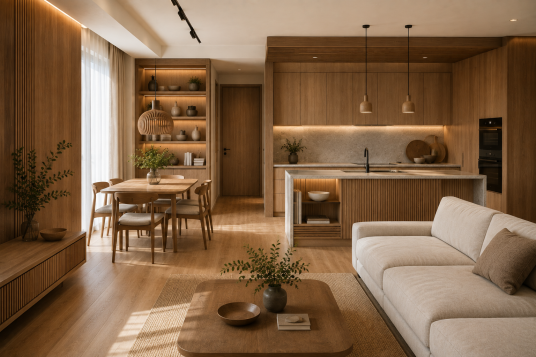
Earthy interior design is an approach to residential spaces that prioritises materials derived from or closely resembling natural earth-based sources: terracotta, raw or limewash plaster, unfinished or brushed timber, stone with visible mineral variation, rattan, jute, linen, and clay ceramics. The palette sits in the warm brown, clay, sand, ochre, olive, and rust range: tones associated with soil, rock, and plant matter rather than with manufactured pigment. Warm home interiors in this register feel grounded because nothing in them looks engineered for perfection. A 2025 peer-reviewed scoping review in Humanities and Social Sciences Communications found that wood coverage, natural materials, and natural surface variation are among the interior design factors most consistently linked to positive physiological comfort and psychological calm. Earthy interiors apply these principles at a whole-room scale rather than through accent pieces alone.
Why Singapore’s Urban Environment Is Driving the Earthy Interior Shift
The appeal of this aesthetic is universal, but its urgency in Singapore is specific. Singapore has one of the highest urban densities in the world. The island’s residential and commercial fabric is almost entirely built from concrete, glass, steel, and composite materials. The outdoor environment most Singaporeans move through daily carries very little of the natural material variation that earthy interiors are built from.
The home becomes the space where that deficit is addressed. When the visual field outside the window is glass, steel, and paved surface, the interior environment has more work to do in providing the sensory contrast that allows the body to register a genuine change of state. A home that uses the same materials as the outside environment provides very little of that contrast. One built from clay-toned walls, stone surfaces, rattan furniture, and unfinished timber provides it immediately and consistently.
This is not the same as a wellness claim about biophilic design. It’s a simpler observation: people who spend most of their day in a manufactured environment tend to feel more settled in a home that is noticeably different from it. The earthy material palette is the most legible way to achieve that contrast in a Singapore condo or HDB renovation.
The Materials That Create This Look in Singapore Homes
Clay-Toned Walls: Terracotta, Warm Greige and Limewash
The wall treatment is the decision that most immediately shifts a room into earthy territory. Clay-toned plaster in terracotta, warm sand, or muted ochre introduces the earthen quality at the room’s largest surface. Limewash paint in a warm greige or aged clay tone carries tonal variation across the wall that reads as organic: the colour shifts slightly with the natural light at different hours of the day, which no flat emulsion paint does.
Terracotta on a feature wall is the most direct earthy feature in a Singapore living room or dining space. It’s not a colour that works in every configuration. It needs either natural light from the east or west, or warm artificial light at 2700K to hold its warmth rather than reading as orange. In the right conditions, it is the material most consistently associated with earthy, grounded interiors across the renovation briefs Singapore designers are receiving in 2026.
Stone and Rammed Earth Surfaces
Stone with visible mineral variation, including travertine, sandstone, limestone, and sintered stone in a stone-effect finish, carries natural material character into horizontal surfaces. A travertine-effect countertop in a kitchen or bathroom introduces the warm, fossil-flecked quality of natural stone at one of the home’s most-touched surfaces. The pitting and variation in the surface is the point, not a flaw.
Sintered stone in a sandstone or limestone pattern offers the same visual quality as natural stone with better durability and lower maintenance, which in Singapore’s humid kitchen environment is a practical consideration as much as an aesthetic one. The surface reads as earthy because the mineral variation is visible at close range: the kind of variation that makes the material feel natural rather than manufactured.
Rattan, Jute and Natural Fibre
Natural woven materials in a Singapore home appear most frequently in furniture and soft furnishings: a rattan armchair frame, a jute rug, a woven seagrass pendant light above the dining table, a linen-weave cushion on the sofa. These materials carry visual texture and surface variation that mass-produced alternatives don’t replicate. The weave pattern in a jute rug is irregular because the fibres are natural. The rattan frame carries a grain and a colour variation that no synthetic material matches.
In a compact Singapore condo, woven and natural materials do the work of grounding a space without adding visual weight. A jute rug under a dining table adds warmth to a floor space without making the area feel smaller. A rattan pendant above the table introduces natural material into the ceiling plane without the heaviness of a metal or ceramic fixture. These are finishing choices, not renovation choices, which means earthy texture can be introduced through furnishings and accessories even when the renovation is already complete.
Unfinished and Wire-Brushed Timber
Timber in this design approach carries the grain forward rather than covering it. High-gloss timber veneer reads as a manufactured surface. Wire-brushed oak, matte-oiled ash, or raw-edge shelving reads as a material that came from somewhere. The grain is visible, the knots and colour variation are present, and the surface communicates the wood’s origin.
In warm home interiors with an earthy palette, unfinished or lightly oiled timber sits most comfortably as a floating shelf, a dining table top, or a feature run of cabinetry in a matte finish. It brings warmth through tone and variation, and it contrasts well with clay-toned walls and stone surfaces because all three materials belong to the same warm, imperfect family.
“Earthy materials don’t need to be styled. They carry their character into the room by existing, which is what makes them feel fundamentally different from manufactured finishes.”
The Earthy Palette: Colours That Create Warmth Without Noise
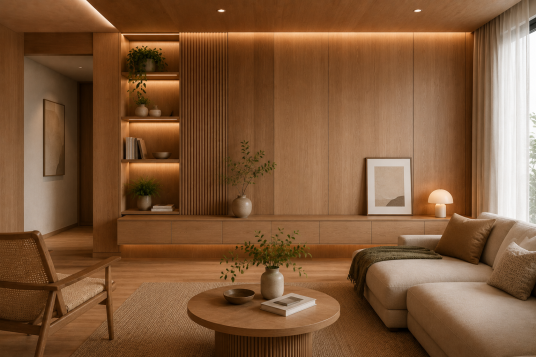
The colour palette in a Singapore earthy home sits in a warm band from off-white through clay, sand, ochre, olive, rust, and brown. These are not complex or unusual colours. What makes them earthy is their tone: a slight dirtiness or mineral quality that prevents them from reading as synthetic.
Pure white walls are not earthy. A warm white with a clay or yellow undertone is. A cool grey is not earthy. A warm greige with a brown base is. Olive green with a grey undertone reads as sophisticated; olive green with a yellow-brown undertone reads as earthy. The distinction is always in the direction the tone pulls: toward synthetic clarity or toward natural origin.
In a Singapore HDB with limited natural light, earthy tones work best at low to mid saturation. A full terracotta on all four walls can feel enclosed in a north-facing room. The same terracotta as a single feature wall with warm white on the remaining three surfaces holds the earthy quality without the weight.
Is Natural Interior Design Right for a Singapore Home?
For any Singapore homeowner whose daily environment is heavily built and stimulus-rich, this material approach consistently delivers the grounded quality that makes coming home feel like a genuine change of state. The materials are practical in Singapore’s climate when specified correctly: sintered stone handles humidity better than natural travertine; wire-brushed timber veneer handles daily contact better than solid unfinished wood; limewash seals well over smooth HDB walls. This approach is not delicate. It’s warm, durable, and designed to look better over time rather than worse.
Frequently Asked Questions
1. What colours work best for an earthy Singapore home?
Terracotta, warm sand, ochre, muted olive, warm greige, clay brown, and rust. These tones share a warmth and a slight mineral quality that reads as natural rather than synthetic. The key test is undertone: earthy colours pull toward yellow, brown, or red rather than toward grey or blue. A warm white with a clay undertone qualifies. A cool white does not.
2. How do organic textures work in a compact Singapore condo?
They add material warmth without floor area impact. A jute rug under a dining table, a rattan pendant above it, and a linen-weave cushion on a sofa introduce natural texture across three zones without occupying any floor space or adding visual weight. These are the finishing choices that give a compact Singapore room the earthy quality that the renovation choices in the walls and floors establish.
3. Can I create an earthy look without a full renovation?
No. Natural woven materials, such as rugs, cushions, baskets, and natural-fibre curtains, are post-renovation choices. Clay-toned limewash paint can be applied over existing smooth walls. Adding earthy elements through natural pottery, timber floating shelves, and rattan furniture requires no renovation work. A full renovation unlocks the material decisions that most define earthy interiors (clay plaster walls, stone surfaces, and matte timber joinery), but meaningful progress is possible through finishing choices alone.
4. How does earthy design differ from biophilic design?
Biophilic design prioritises the relationship between the home and living nature: indoor plants, natural light, views of greenery, and materials that connect the space to outdoor ecology. The earthy approach is more specifically a material and palette approach, using earth-derived surfaces and warm natural tones to create a grounded sensory environment. The two overlap but aren’t the same: a biophilic room might use cool glass walls and abundant indoor planting; an earthy room might have minimal planting but heavy use of clay, stone, and rattan.
5. Do earthy tones make a Singapore room feel smaller?
Not if they’re used at the right saturation. A full terracotta on four walls in a 10-square-metre Singapore bedroom will feel enclosed. The same terracotta as one feature wall with warm white on the others holds the earthy warmth and warmth without reducing the perceived space. Earthy interiors in compact Singapore homes work best when the most saturated tone appears on one surface and the remaining surfaces stay in the lighter end of the warm neutral range.
The pull toward earthy interiors in Singapore isn’t nostalgia for a pre-urban environment. It’s a response to one that offers very little of the material variation and sensory contrast that natural surfaces provide. Terracotta walls, stone countertops, rattan furniture, and unfinished timber shelving do something in a Singapore home that glass and polished concrete can’t: they give the eye somewhere to rest and the hand something that carries the memory of where it came from. Natural interior design built from these materials doesn’t just look different from the city outside. It feels different. If you’re planning a Singapore renovation and want to bring earthy grounded quality into the brief from the start, speak with the LOME Interior team. For more on how natural materials and organic textures translate into specific design decisions, the LOME Interior guide to textural design and the biophilic design principles that underpin this approach are worth exploring alongside.
