
Key Takeaways
- Luxury interior design Singapore homeowners admire in hotels isn’t a visual category. It’s a sensory and spatial one built from specific planning decisions.
- Hotel-inspired interior design works at home because it prioritises how a room feels to move through, not just how it looks in a photograph.
- The entry sequence, surface restraint, layered lighting, and material quality are the four disciplines that separate hotel-quality interiors from well-styled ones.
- Boutique home style is achievable in a Singapore condo or HDB without hotel budgets, because the principles are about decision-making, not spending.
- Premium finishes earn their place in hotel-inspired interiors when they appear in the right locations, not when they’re used everywhere.
Introduction
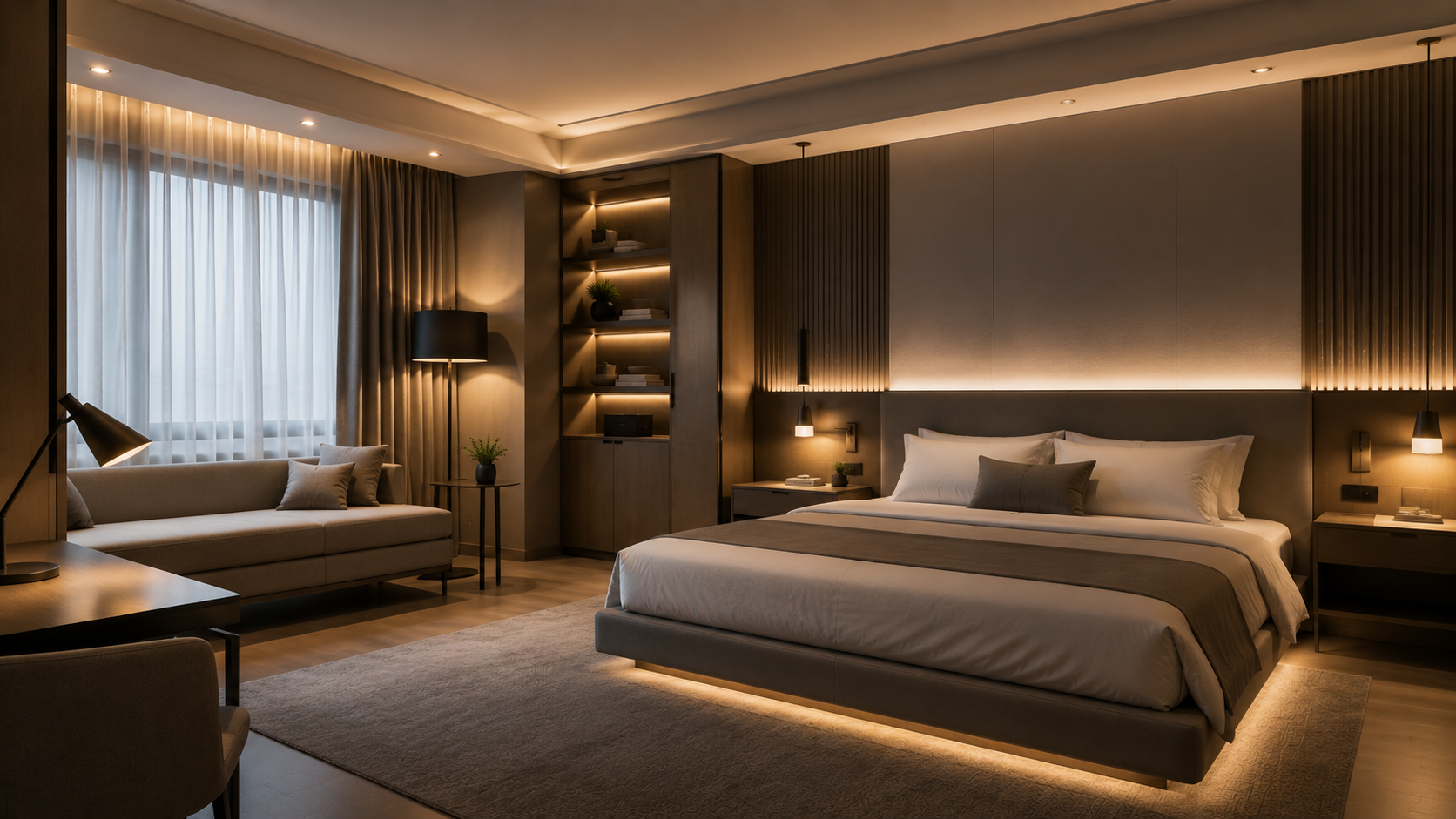
Walk into the lobby of a well-designed boutique hotel in Singapore and notice what happens. The air feels cooler. The noise drops. The eye settles on a composition of materials rather than a collection of objects. You haven’t checked in yet and the space already feels like a place you want to stay.
Most Singapore homeowners recognise this quality instantly and want it at home. The renovation boards fill with references to the Warehouse Hotel, the Capella, and boutique properties in the Keong Saik area. The brief always includes words like calm, considered, and luxurious. And then the renovation is completed and the result feels more like an upscale apartment than a hotel.
The gap isn’t in the budget. It’s mechanism. Luxury interior design Singapore residents experience in hotels is built from four specific design disciplines that most residential renovations don’t address. Understanding what they are and how they translate into renovation decisions is what makes the difference between a home that looks expensive and one that genuinely feels like a hotel.
What Is Hotel-Inspired Interior Design?
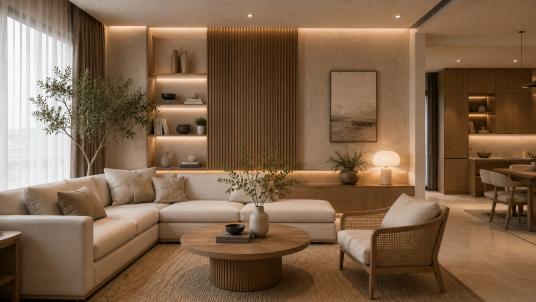
Hotel-inspired interior design is the application of hospitality design principles to residential spaces, specifically the disciplines hotels use to create a consistent experience of calm, quality, and comfort for guests who arrive as strangers and leave wanting to return. In a residential context, it means designing a home so that moving through it feels as considered as the destination rather than the journey. The principles include deliberate entry sequencing, restrained surface composition, layered lighting that shifts by time and activity, and the placement of premium finishes at high-contact points rather than uniformly throughout. A 2024 peer-reviewed study in the Journal of Hotel and Business Management confirms that hotel design affects guest comfort not primarily through aesthetics but through layout, material composition, and the sensory logic of how spaces are sequenced.
The Entry Sequence: Where the Hotel Feeling Begins
The most underestimated discipline in hotel-inspired interior design is also the first one a guest or resident encounters: the entry sequence. Hotels understand that the quality of an arrival experience sets the emotional tone for everything that follows. The transition from outside to inside is designed as a decompression zone, a spatial pause between the public world and the private one.
In a Singapore condo or HDB, the entryway is typically a 1.2 to 1.5 metre corridor leading directly into the living area. Most renovations treat it as a functional zone for shoes and coats rather than as a threshold with its own spatial character. That’s the first departure from hotel thinking.
A hotel-inspired entry sequence in a compact Singapore home does three things. First, it controls sightlines. Rather than the living room being immediately visible from the front door, a full-height joinery panel or a material change on one wall creates a brief pause before the main space opens. Second, it changes the floor material or level, even by a few centimetres, with a step or a rug, to physically signal arrival. Third, it uses a scent or lighting change, whether a recessed downlight positioned to create a warm pool of light or a diffuser near the door, to engage the senses before the room is fully visible. None of these requires a structural change. All of them require thinking about the entry as a designed experience rather than a pass-through.
“The entry sequence is where the hotel feeling either starts or doesn’t. A front door that opens directly into a fully visible living room skips the moment of arrival entirely.”
Surface Restraint: What Hotels Do That Most Homes Don’t
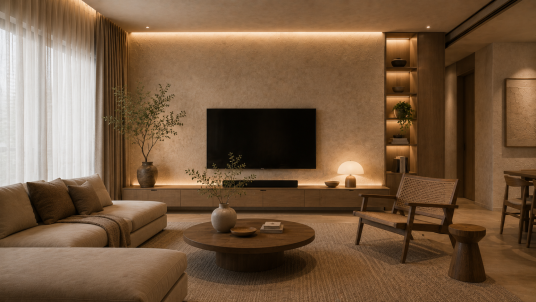
Walk through the guest room of a well-designed boutique hotel and count the visible surfaces. The number is almost always lower than you’d expect. One primary material on the walls. One floor material running continuously. One joinery finish on all cabinetry. Two accent materials at most, placed at deliberate points of visual interest.
This is surface restraint, and it’s the design discipline most responsible for the quality that makes boutique home style feel expensive without being identifiable as any specific budget level. The feeling of luxury doesn’t come from using many premium materials. It comes from using a small number of them consistently enough that the room reads as a single composed environment rather than a collection of choices.
In a Singapore residential renovation, surface restraint means making three decisions early and holding to them: the primary wall treatment (paint colour and finish), the floor material, and the joinery finish. Everything else in the room, soft furnishings, lighting, accessories, responds to those three rather than competing with them. A warm greige limewash on the feature wall. Engineered oak across the living and bedroom floors. Warm white lacquer on all joinery. These three decisions, distributed consistently, create the tonal coherence that makes a room feel designed.
Premium finishes earn their place in this framework when they appear at high-contact points: the countertop surface you touch every morning, the door hardware your hand lands on dozens of times a day, the bathroom tap fitting you use twice daily. These are the surfaces that communicate material quality through touch rather than just sight. A sintered stone countertop in a bedroom vanity. Solid brass hardware on joinery doors. A linen-wrapped headboard that responds to the hand. These are hotel-quality decisions because hotels invest where the guest makes contact, not where the guest just looks.
Layered Lighting: The Detail Hotels Never Get Wrong
No discipline separates hotel-inspired interior design from a well-renovated apartment more consistently than lighting. Hotels never use a single overhead light source in any room intended for rest. The principle is simple: overhead light creates a flat, evenly lit environment that reads as functional. Layered light at multiple heights and intensities creates an environment that reads as designed for a specific experience.
Layered lighting is one of the most requested elements in luxury interior design Singapore renovations in 2026, and for good reason. It works across three circuits that operate independently. An ambient layer provides general room illumination, typically a recessed cove or perimeter downlights rather than a ceiling panel. A task layer provides focused light where reading, dressing, or working happens. An accent layer highlights the surface or architectural element around which the room is composed, whether a textured feature wall, a piece of joinery, or a bedhead.
The key detail is dimmability. A hotel room shifts from bright to dim by pressing a single switch or turning a dial. A Singapore home renovation that specifies dimmable circuits on each layer allows the same room to function at full brightness for morning routines and shift to a soft, warm ambience for evenings without any change to the space itself. This is not a feature. It’s the mechanism through which a room becomes hotel-quality at specific hours of the day.
Colour temperature is the supporting decision. Hotels use warm white at 2700K to 3000K throughout guest rooms because that temperature is associated with rest and high-end hospitality environments globally. Singapore homes that maintain the same temperature across the bedroom, bathroom, and living zones create a consistent sensory experience moving through the home.
“A hotel room at night feels completely different from the same room in the morning, without anyone moving a single piece of furniture. That’s what lighting layers do.”
Premium Finishes: The Hotel Rule of Contact Points
Hotel rooms don’t use premium finishes everywhere. They use them at the points where a guest makes physical contact, because touch communicates quality more immediately than sight. The bed linen thread count. The weight and texture of the bath towel. The smooth action of a door handle. The cool, solid surface of a marble bathroom countertop. These are the details that leave a physical impression because they’re felt rather than observed.
In boutique home style for a Singapore renovation, premium finishes follow the same rule. The justification for a higher-specification material is not decoration. It’s contact frequency. A quartz or sintered stone kitchen countertop is touched dozens of times a day and communicates its quality every time. The same budget spent on a premium tile backsplash in a pattern communicates primarily through sight and in a smaller space than the counter. The hotel logic prioritises the former.
Four contact-point decisions consistently elevate a Singapore home toward hotel-quality finish. The bedroom floor material, because bare feet on a cool morning communicate the floor’s quality instantly. The bathroom countertop and tapware, because every morning routine begins there. The main joinery hardware throughout, because handles are touched more than they’re seen. And the primary seating upholstery, because how the sofa feels when someone sits down after a long day at work is the equivalent of how the hotel bed feels at the end of a travel day. These four points are where the renovation budget earns its return.
Can You Achieve Hotel-Quality Luxury Interior Design in a Singapore Home?
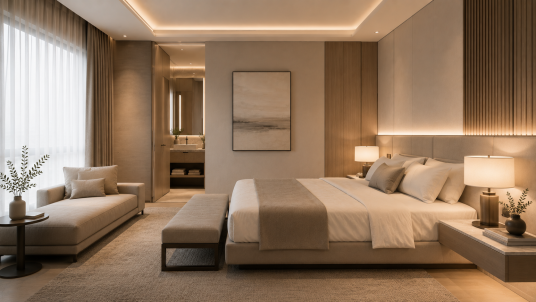
Yes, in a Singapore condo or HDB. The principles that create the hotel feeling at home, deliberate entry sequencing, surface restraint, layered and dimmable lighting, and premium finishes at contact points, are planning disciplines rather than budget categories. A renovation that addresses all four can achieve the hotel-inspired quality most homeowners want without requiring hospitality-grade budgets. What it requires is making these decisions at the planning stage, before carpentry, electrical, or material choices are finalised.
Frequently Asked Questions
1. What is the single most important decision for creating hotel-inspired interior design at home?
Lighting. Specifically, dimmable circuits on at least two independent layers: an ambient layer for general illumination and an accent or task layer that can operate independently. No other single decision changes how a room feels at different times of day as significantly as independently controlled, warm-toned lighting at multiple heights.
2. How do I achieve boutique home style in a compact Singapore HDB?
Focus on surface restraint: choose one primary wall treatment, one floor material, and one joinery finish, then hold those three decisions consistently across the space. A compact HDB responds to restraint more visibly than a large home does because the limited floor area means every surface is always in view. Adding premium finishes at the three or four contact points that matter most, the floor underfoot, the door hardware, and the bathroom counter, completes the effect at a manageable cost.
3. Do premium finishes have to be expensive to create a hotel-quality feel?
No. The hotel principal is a contact-point investment rather than a uniform premium. Solid brass hardware on joinery doors costs more than standard hardware but represents a small proportion of a renovation budget. Engineered oak flooring in the bedroom delivers the underfoot quality of a hotel room without the cost of solid timber. The decisions are about where in the renovation the quality is concentrated, not about the total spend.
4. What is surface restraint and why does it matter for hotel-inspired design?
Surface restraint is the practice of limiting the number of materials in a room to three or fewer primary surfaces, then distributing them consistently. It matters because most rooms that feel expensive in hotels do so because the eye has very few competing materials to process. The room reads as composed rather than assembled. In a Singapore home, this means deciding on a primary wall treatment, floor, and joinery finish before any other selections are made.
5. How does the entry sequence affect the feel of a Singapore home renovation?
The entry sequence controls the emotional transition from outside to inside. A well-designed entry creates a brief pause before the main living space becomes visible, using a material change, a lighting shift, or a controlled sightline to signal arrival. Without this, the living room is immediately visible from the front door and the home feels like it starts at the threshold rather than drawing you in. This is one of the lowest-cost and most impactful interventions available in a Singapore HDB or condo renovation.
The hotel feeling that most Singapore homeowners want at home is not a mood board category. It’s the result of four specific disciplines applied in sequence: a deliberate entry that controls how the home is first experienced, surface restraint that makes the room read as composed rather than decorated, layered lighting that allows the same space to feel different at different hours, and premium finishes placed where they’re felt rather than just seen. Any Singapore renovation that addresses these four decisions will achieve the quality that distinguishes a hotel-quality home from a well-furnished one. If you’re planning a renovation and want these principles built into the brief from day one, speak with the LOME Interior team. For more on how resort and boutique hotel aesthetics translate into Singapore residential design, the LOME Interior resort style design guide and the mid-2025 condo interior design trends cover the broader aesthetic landscape these principles sit within.
