
Key Takeaways
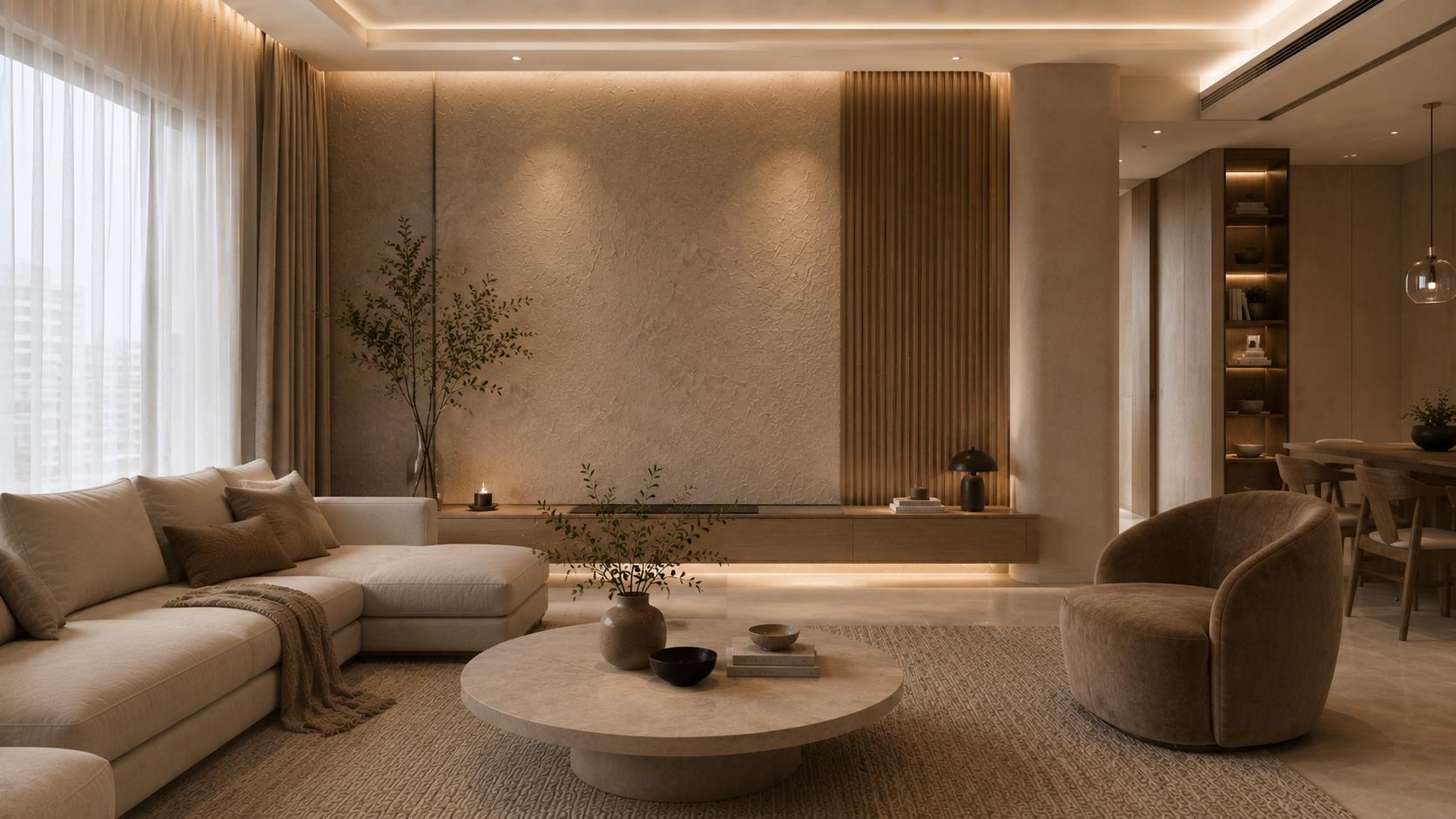
- Modern interior design Singapore homeowners are gravitating toward in 2026 sits between pure minimalism and conventional luxury, combining clean lines with warmth and tactile quality.
- Soft modern interior design is defined by warm neutrals, organic material surfaces, restrained ornamentation, and lighting that creates atmosphere rather than illumination.
- Minimalist luxury is not a contradiction. It describes a room with very few elements, where each one is chosen for quality and placed with precision.
- The decisions that place a home in soft modern territory are made during renovation, not during styling: material selection, furniture profile, and lighting circuits.
- Contemporary interiors in Singapore work in this register because the aesthetic rewards restraint, and compact floor plans make restraint the practical choice as well as the visual one.
Introduction
Most Singapore homeowners planning a renovation land somewhere between two briefs they can’t quite name. They don’t want the coldness of strict minimalism: the all-white surfaces, the absence of texture, the rooms that feel like showrooms rather than homes. But they don’t want the weight of conventional luxury either: heavy drapes, ornate joinery, finishes that announce themselves rather than settle.
The aesthetic they’re describing has a name in 2026: soft modern. Modern interior design Singapore designers are being briefed to produce more often than any other single register. It’s the range where Singapore homes stay uncluttered and architectural, but replace cold precision with warmth, natural variation, and quality of material.
What makes soft modern difficult to brief is that it’s defined by calibration rather than category. Shift any one element too far in either direction (too stark, too ornate, too sparse, too busy) and the register is lost. Understanding what holds it in place is what makes the renovation decisions clear.
What Is Soft Modern Interior Design?
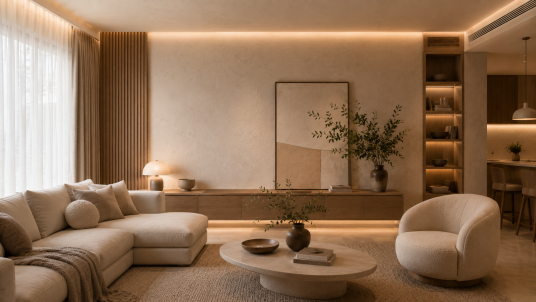
Soft modern interior design is a residential design register that maintains the structural clarity and low visual noise of minimalism while introducing warmth through material choice, organic form, and calibrated lighting. It avoids the austerity of strict minimalism by using natural surfaces with visible grain or texture, warm colour palettes, and furniture with gently curved profiles. It avoids the opulence of full luxury design by keeping the element count low, the palette restrained, and every decorative decision purposeful rather than demonstrative. A 2025 peer-reviewed scoping review in Humanities and Social Sciences Communications found that natural material surfaces and lighting quality are the interior design factors most consistently associated with comfort and positive physiological response in residential spaces, which is precisely the quality that soft modern design prioritises over visual complexity.
How Soft Modern Differs From Pure Minimalism
Strict minimalism in a Singapore context means white or near-white walls, smooth flat surfaces on all joinery, an absence of visible material variation, and furniture chosen to disappear rather than register. The visual discipline is genuinely demanding and produces spaces that read as calm precisely because there is nothing to interrupt the eye.
The problem is that nothing to interrupt the eye is also nothing to land on. A room without visual warmth or tactile variation asks the eye to keep moving rather than rest. This aesthetic solves that by introducing one or two elements of material character within an otherwise minimalist structure. A single limewash feature wall in a room of smooth painted surfaces. An oak veneer joinery run that introduces grain alongside white lacquer panels. A curved sofa silhouette in a room of otherwise rectilinear architecture.
None of these additions violates the minimalist principle of low element count. They change the quality of what’s present rather than adding more things. That’s the distinction: soft modern uses fewer elements than conventional design, but it demands more from each one.
How Soft Modern Differs From Conventional Luxury
Conventional luxury in residential interiors reads through the quantity of premium material and the elaboration of detail. Marble throughout rather than at a single counter. Ceiling coffers with detailed moulding. Statement lighting fixtures chosen to be noticed. Layered drapery in rich fabric. Each element declares the investment it represents.
The soft modern approach applies the budget logic of luxury differently. Rather than distributing premium quality across many surfaces, it concentrates it at one or two contact points where the material quality is felt rather than just seen. A sintered stone kitchen countertop in an otherwise matte laminate kitchen. Solid brass tapware in a bathroom with simple ceramic tile. A linen-upholstered sofa that responds to touch in a room with otherwise standard materials.
This is minimalist luxury in practice. The room doesn’t announce its quality. A visitor feels it gradually: the weight of the door handle, the surface of the countertop, the texture of the upholstery. Contemporary interiors in this register are confident rather than demonstrative.
“Conventional luxury shows you what it costs. Soft modern lets you discover it.”
The Five Renovation Decisions That Create Soft Modern
Warm Neutrals Over Cool Whites
The colour palette in soft modern Singapore interiors sits in the warm neutral range: creamy whites with a yellow or pink undertone, warm greiges, soft clays, and muted olive tones. These are not pure whites, which pull cool, and not strong colours. They’re tones that hold warmth without commitment, which means they read differently across Singapore’s varied natural light conditions: softer in north-facing units, richer in west-facing ones.
Choosing these tones at the renovation stage, before the floor and joinery are in place, is the correct sequence. A warm greige wall that works alongside an oak floor and white joinery needs to be chosen in relation to both of those surfaces. Choosing it from a paint sample in isolation is how colour decisions go wrong.
Organic Material Contrast
The defining surface decision in this register is using at least two materials with distinctly different tactile qualities in the same room. The contrast between a smooth lacquered joinery face and a timber veneer section in the same unit. The contrast between a matte-painted wall and a limewash feature panel. The contrast between an engineered stone countertop and a timber shelf above it.
This contrast is what prevents the design from reading as cold minimalism. The eye moves between the smooth and the textured surface and the room acquires depth. Modern interior design Singapore professionals who work in this register specify the material contrast at the joinery stage, so the two surface types are integrated into the furniture design rather than added as an afterthought.
Curved Furniture Profiles
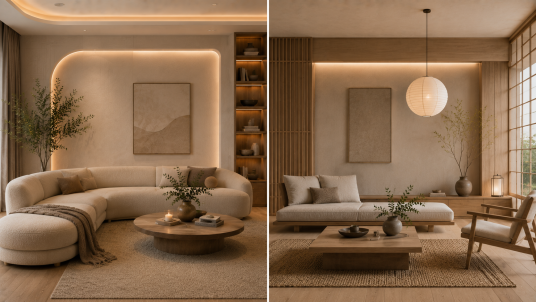
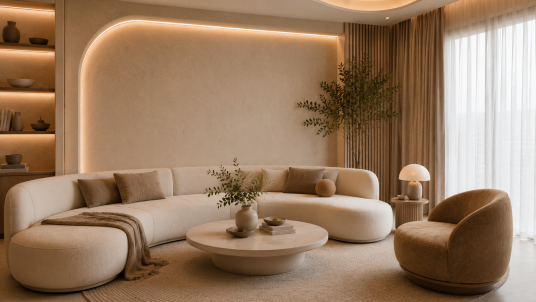
The furniture silhouette in soft modern contemporary interiors almost always includes at least one curved element. A rounded armchair. A sofa with a gently arched back. A dining table with an oval or rounded-rectangle top rather than a rectangle with sharp corners. These curves soften the geometry of an otherwise clean-lined room without introducing ornamentation.
The practical effect in a Singapore condo is also spatial. Curved or rounded furniture forms create better sightlines from the entry of an open-plan living space because they don’t divide the room into hard geometric blocks. A rounded sofa allows the eye to travel across the room without stopping at a corner.
Warm Dimmable Lighting
This aesthetic cannot exist under cool white overhead lighting. The warm neutral palette, the organic material surfaces, and the textured finishes all read flatly under 4000K. Warm white at 2700K to 3000K, distributed from at least two independently controlled sources, is the lighting specification that activates the aesthetic.
In a Singapore renovation, this means dimmable circuits for the ambient layer and at least one accent or task source that operates independently. The ambient layer dims for evenings and social use. The accent source stays on to activate the feature surface: the textured wall, the timber joinery, the countertop material. Without this spec confirmed at the electrical planning stage, the soft modern result is difficult to achieve after the renovation is complete.
One Deliberate Luxury Detail
The final decision is choosing one element that reads as distinctly high-quality and placing it where it will be encountered daily. This is minimalist luxury in practice: not a uniform elevation of all materials, but a single point of premium investment that anchors the room’s sense of quality.
In a living room, this might be the upholstery fabric on the primary sofa: a boucle, a heavyweight linen, or a velvet in a muted tone. In a kitchen, it is the countertop material and the tapware finish. In a bathroom, it is the vanity tap and the floor material underfoot. One element per room, specified for quality of touch rather than visual statement.
“In soft modern design, the luxury detail doesn’t announce itself. It’s the thing a visitor notices on the way out rather than on arrival.”
Is Soft Modern Interior Design Right for a Singapore Home?
For Singapore homeowners who find strict minimalism too cold and conventional luxury too heavy, yes. The soft modern register occupies the range where a compact Singapore home can feel considered, warm, and high quality without visual density or the maintenance demands of elaborate material choices. The decisions that hold it in place (warm neutrals, organic surface contrast, curved furniture profiles, warm layered lighting, and one premium contact-point detail) are renovation and specification choices, not styling ones.
Frequently Asked Questions
1. What is the difference between soft modern and Japandi?
Both aesthetics value restraint, natural materials, and warm neutral palettes. Japandi leans further toward the minimal and tends toward cooler greys alongside natural tones, with a stronger emphasis on craftsmanship over comfort. Soft modern is warmer, allows more organic surface variation, and places more emphasis on tactile quality and furniture comfort than on the precise discipline of Japandi’s material rules. A soft modern room typically has softer furniture profiles and more visible texture than a Japandi one.
2. What colour palette works best for soft modern design in Singapore?
Warm neutrals: creamy whites with a yellow or pink undertone, warm greiges, soft clay, and muted olive. Pure white reads cool and belongs to strict minimalism. Strong or saturated colours sit outside soft modern. The palette can vary in depth from room to room, lighter in bedrooms and richer in living areas, but should remain in the warm neutral family throughout to maintain visual coherence.
3. How does minimalist luxury work in a small Singapore condo?
By concentrating premium quality at the points of daily contact rather than distributing it uniformly. One high-quality countertop, one premium fabric upholstery, and one well-specified tapware finish. In a compact condo, this approach is actually more effective than uniform elevation because the limited floor area means every surface is always close enough to feel. Touch communicates quality more immediately in a small space than in a large one.
4. What furniture profiles work best in soft modern Singapore interiors?
Furniture with gentle curves or rounded edges on at least one primary piece per room. Sofas with arched or softly rolled backs. Dining chairs with curved seat shells or rounded legs. Coffee tables with oval or rounded-rectangle tops. These forms soften the geometry of a clean-lined Singapore interior without adding ornamentation. Avoid furniture that is either too angular (which reads as cold minimalism) or too ornate (which reads as traditional luxury).
5. Does soft modern design suit HDB renovation in Singapore?
Yes. HDB flats respond particularly well to this register because the floor areas reward restraint and the warm neutral palettes work across the varied natural light conditions of north, south, east, and west-facing units. The key constraint is ceiling height. HDB flats typically sit at 2.6 metres, which means the furniture scale needs to be kept proportional. Low-profile sofas and furniture with visible legs maintain the soft modern openness better than heavy, ground-hugging pieces.
The space between pure minimalism and conventional luxury is where most Singapore homeowners actually want to live, and it is where the best modern interior design Singapore firms are working today. This register holds that space: fewer elements, better quality, warmer materials, and lighting that works with the surfaces rather than flattening them. The decisions that create this result happen during the renovation, not the styling, which is why getting the material selection, furniture brief, and electrical specification right from the start determines the outcome. If you’re planning a renovation in Singapore and want your home to sit in this range, speak with the LOME Interior team before material and joinery decisions are finalised. For reference on how minimalist and luxury registers interact in Singapore interiors, the LOME Interior guide to luxe minimalist design and the mid-2025 condo interior design trends outline where the market is moving and why.
